
Our area · Sand Springs, Oklahoma
Landscaping in Sand Springs.
Rolling hills, stony ground and the Arkansas River. In Sand Springs, slope and drainage come up on almost every yard, and the city's own rules expect them to.
01In Sand Springs
02Specifics
Building in Sand Springs.
Hills, stone and river bottom
The city describes its topography as rolling hills and trees that "must be effectively preserved." USDA soil maps back that up: the hills around Sand Springs are dominated by Niotaze-Bigheart-Rock outcrop complexes on slopes from 3 to 45%, stony to rubbly. Niotaze soils formed from shale and sandstone and are somewhat poorly drained.
Downtown is different ground: Choska and Severn soils on the flat river bottom. A hillside yard needs walls, steps and water control; a yard near the river mostly needs grading and drains.
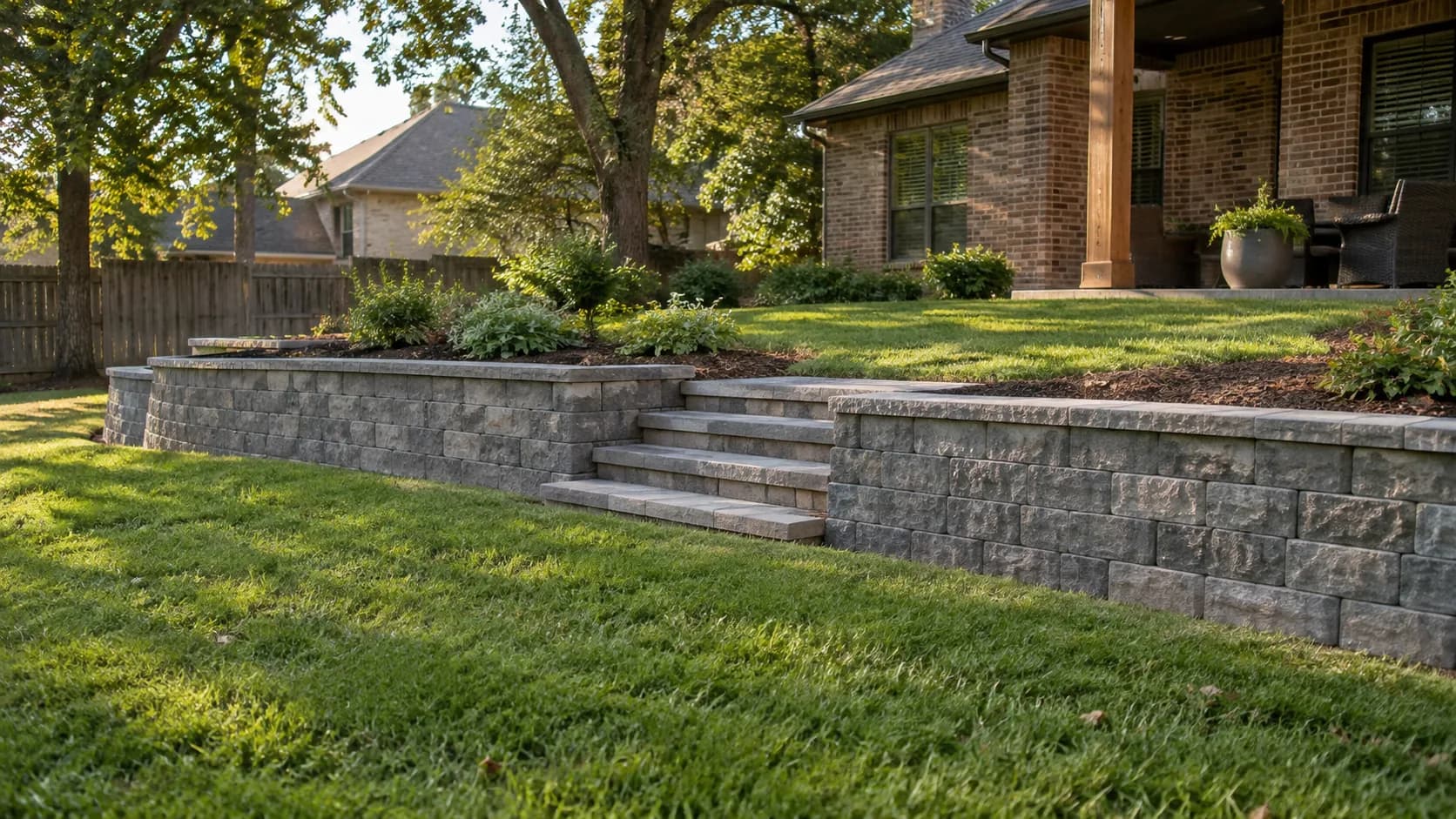
Retaining walls and grading
Sand Springs counts building a retaining wall as an earth change. Its code requires retaining walls where new construction would leave slopes in erodible soil steeper than 3 horizontal to 1 vertical, bars walls over easements, and has the City Engineer approve the design of any wall over 4 feet whose failure could affect a neighbor or the right-of-way. The city's brochure says Public Works reviews plans and inspects all retaining walls 4 feet or higher.
Landscaping that doesn't change drainage into or out of the right-of-way is exempt from the earth change permit, as is grading with less than 6 feet of cut or fill at any point, unless the retaining wall rule applies.
Fences, patios and structures
Sand Springs doesn't require a permit or inspection for fences. The zoning code limits them to 4 feet in front of the house and 8 feet behind its front. Subdivision covenants, which the city doesn't enforce, may ban front-yard fences.
Patios belong in the rear yard. Detached accessory buildings can cover 20 to 30% of the required rear yard, depending on the district, and must stand at least 5 feet from any lot line.
Floods and water shortages
Sand Springs takes part in FEMA's Community Rating System, and work in a flood area needs a floodplain development permit. Its 2024 floodplain report notes that the Meadow Valley buyout removed 28 flooded structures, with 20 repetitive-loss structures still in that neighborhood.
In a Stage Two water shortage, outdoor watering drops to every fifth day by address. Commercial landscapers can get a permit from the City Clerk to water new sod and plantings during installation and for 10 days after.
Who to call
Neighborhood Services handles building permits and inspections at 100 E. Broadway St., (918) 246-2572, 8 a.m. to 5 p.m. weekdays. Earth change permit questions go to Public Works at (918) 246-2588.
03Questions
Common questions.
- Do I need a permit for a fence in Sand Springs?
- No. Sand Springs doesn't permit or inspect fences, but limits them to 4 feet in front of the house and 8 feet behind it.
- Who reviews retaining walls in Sand Springs?
- Public Works reviews plans for and inspects retaining walls 4 feet or higher, and the City Engineer approves the design of taller walls that could affect a neighbor or the right-of-way.
- Can I water new sod during a water shortage in Sand Springs?
- In a Stage Two shortage, commercial landscapers can get a City Clerk permit to water new installations during the work and for 10 days after.
- Do I need a permit to regrade a yard in Sand Springs?
- Grading with less than 6 feet of cut or fill is exempt from the earth change permit unless a retaining wall is required. Call Public Works at (918) 246-2588 to confirm.
Working in Sand Springs?
Send a few photos and tell us what the yard needs. Your quote sets out the work, the materials and any permits before you decide.
Related guides
Hardscaping
Signs your retaining wall is failingHardscaping
Do you need a permit for a retaining wall in Tulsa?
Sources
- City of Sand Springs, earth change permit brochure (PDF)
- USDA NRCS Soil Data Access (Web Soil Survey data)
- USDA NRCS, Niotaze soil series description
- City of Sand Springs, Title 15 (PDF): earth change and retaining walls
- City of Sand Springs, fence FAQ
- City of Sand Springs, Zoning Code (PDF)
- City of Sand Springs, Floodplain Management Plan
- City of Sand Springs, Title 13 (PDF): floodplain and water shortages
- City of Sand Springs, Building Inspections